Shadows, shadows!

Shadows never travel absent sun, and the shadows cast in Jack Jones’ first poetic offering boldly script the lived experience of a son rising into consciousness during the last century’s most defining American moments. Through the eyes of this young white man, Shadows speaks with a tongue raw and uncomfortably descriptive. With howling  consciousness, this poet steps into sunlight, casting aside the shadow of whiteness that has blanketed the American experience since its founding. Jones commands of himeslef a hueman  identity, and demands of the institutional other recognition of his huemanity.

Despite its raw witness, the 17 poems in this chapbook do not dwell on life’s darkside or speak from any fringe. 30-years creative silence has given Jones the perspective and audcacity to take the reader into his consciousness as its lived experience emerges. These poems are not conceptual. A major part of the work pulses with a youthful swagger, and the Blues of the Crescent City is set just right to reveal the poet’s inquiry: How (were) you living?

All the poison competes. / You are dying inside out from everything you can’t defeat. / Your decay turns into a painful morbid delight. / You’re an underground man, / Never to be left at peace.

The poet explores critical moments of insight immersed in the culture of the South’s busiest slaving port during the Maafa,  Jones’ creativity resonates with a traditional Blues holler, living amid facets of Black cultural resistance and opression. This young white man is a witness reporting raw data from daily Black life, through his privileged lens. Every detail captured in this work stands as a counterpoint to the myth of white American exceptionalism. This poetry confronts contradiction head-on. Few ideas here, just life through a white lens.

If poetry begins with identity, then, Jones’s struggle with capitalism’s clutch on identity formation is the shadow that shrouds our ignorance to life’s detail. This poet’s eye is one of America’s vital organs. His poems, crafted from the archive of youth, should be read by all introspectively, as though peering into a mirror that questions one’s identity, in search of authenticity.

How did the poet’s psyche, his soul intersect Civil Rights/Black Power/Black Arts and AntiVietnam War, and the radical white Left movements? How do the poems here

reflect on the shaping of his consciousness, his intersection with the economic, social, and polical platform that hhave privileged him? To be young, male, and white coming of age during America’s most turbulent era of the last century, seems to have been Jones’s American dilemma, shaping his Self and worldview? From a crisp predawn, street images stark against his release from a 30-day stint in jail.

after 30 days flat-time house of d. / hungry, near broke, roamin’ free.
/ tryin’ in vain outpace pre-dawn morning. / past french quarter, st. thomas, dripping / gray shadows, farmers market. covered / dark men, beddindown, atop crates: collard greens, celery, sacks rice, truck beds.

Shadows begs of the reader how this period, whether lived experience or not, has impacted your life — effecting your mind and material well-being today?
\By leaping backward to the development of his critical Self insight, Jones, unlike the best minds of Ginsberg’s generation,  immersed in those streets as witness, reckoning the foul breath of experience.

Both agony and ecstacy are hard-won in these Shadows. Here in the bowels of the city and the poet’s consciousness we must see beyond filty toilets, shotgun tenements, crowds in the going-home-festive streets, and the jail cell to open a geography of the poetic Self in a post-WW2 world of whiteness.

ugly horrible sounds heard roaches rats disease eating children
capitalism’s inner-city ghettos reservations policed by a militarized force

Customers scream, / move away from black man / in flight. . . / Black man—running, staggering through / Canal Street traffic—report, gun fired. / Black man’s body jerks violently backwards, / shot middle of back.

Whiteness is more than an idea. Jones bears witness to the clutch of capitalism, in his youth, and holds up the moirror of today’s continuity of whiteness. His political consciousness rooted.

In the howl / I am human being / refusing / death / alive / I am human being

Horse is again growing strong / Horse is again growing strong.

A half century ago, this poet saw what today’s America looks like and spoke it clearly with the rawness it deserves. The poet as chronicler seeks justice. Words will never produce justice, but they may split the clouds for the sun to illuminate the landscape and warm our faces. Peace is hard won in one’s own heart and mind. From the back bench of maturity—50-years after the writing of many of these pieces—rounding out his recollection, Jones takes us from New Orleans to recall America’s bootheel on the neck of the Southern Hemisphere.

woe the hour of vengeance the stadium’s cadavers beseech /
a single glow of man-made light now joins

Shadows is a searchlight for a liberated gaze of beauty’s everyday rising against the terminal ugly backdrop of America. Shadows is a must read for conscious folk questioning the authority of whiteskin allegiance, complicity, and corporate control.

It’s the juju of rebellion in Jefferson and Trump’s America. After 30-years absence, the poet has reemerged. Why? He says,

If not now, when, and hopefully to contribute to the end of the empire, even if after my death. Also, it is what poets do with their verse, unless you are an Emily Dickinson (type).

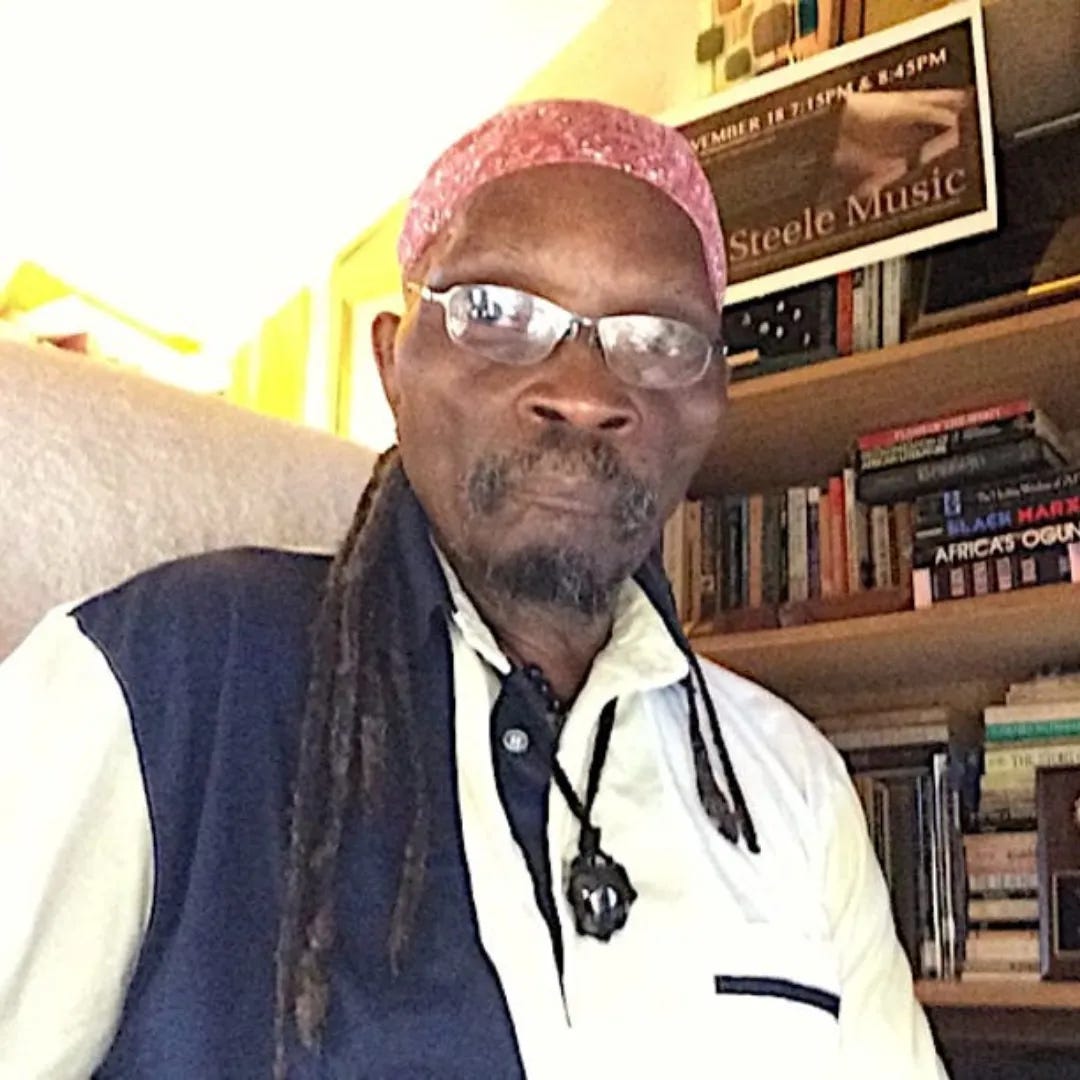
Omowalé-Kétu Oladuwa